

The Yard
The revival of shipbuilding in 1950 saw the industry return to the
original Berwick site where a yard had first been established
almost 200 years before.
The Quay Walls Shipyard Site
Shipbuilding on the Berwick Quay Walls site
dates to the mid-eighteenth century. The
founder of the first yard, Arthur Byram, lived
just a short walk away at a house in 25 Palace
Street.
Following the yard's closure in 1878 part of the
shipyard site was given over to herring curing.
Further development took place in 1903 when an
electrical generating plant was built by the Urban
Electric Supply Company Ltd in the area adjacent
to the slip. The plant became operational the
following year. The buildings later served as a
storage facility for the South of Scotland
Electricity Board. They survived throughout the
period when the the yard was in operation but
were later demolished.
When shipbuilding at Berwick was revived by
William Weatherhead and Son in 1950, the Quay
Walls site was a cobble-stoned grass-bordered
car park with little to indicate its former use.
Considerable work had to be undertaken before
shipbuilding could get underway. A new concrete
slipway was laid over the old one that had been constructed more than one hundred years before. Steel bogies drawn by a 50
h.p. winch were built to cradle vessels while they were being built. Buildings were prepared and adapted to accommodate
plant and workers. A building previously used as a Customs shed for example, was converted into a mould loft. New
structures erected on the site included a plate fabrication shed within which were installed heavy machinery including a
shearing machine and roller.
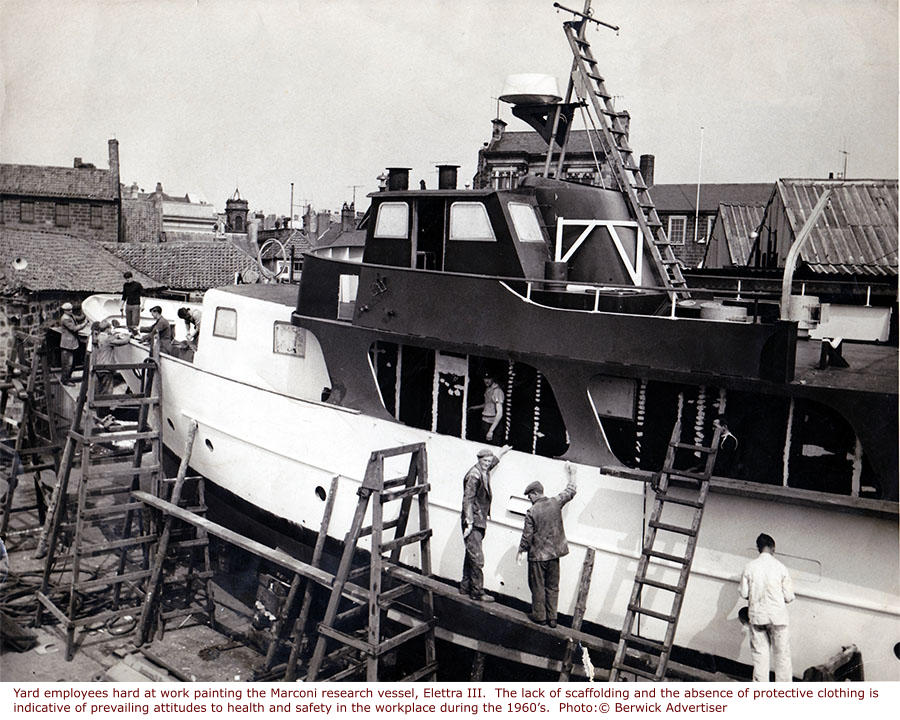
During the lifetime of the yard much of the site remained uncovered. The absence of covered building sheds and exposure to
the elements meant difficult working conditions for many staff. Former workers could recall how during the winter fires would
be lit in oil drums on the exposed decks of vessels for warmth. Recalling conditions at the yard one ex-worker described it as
"the coldest spot south of the Arctic Circle".
In 1964 the landscape of the yard changed with the erection of a giant shipyard crane. Manufactured by Butter Brothers of
Glasgow the jib had a maximum working radius of 38 metres and a lifting capacity of 7 tons. Previously heavy loads were
manoeuvred into place by way of derricks. The shipyard crane would come to dominate the view of the town from the south
until the yard’s closure in 1979 when it was sold for scrap and dismantled.
The Workforce
To establish a yard capable of constructing
modern steel vessels the firm of William
Weatherhead and Sons in 1950 had to recruit
skilled workers from Scotland and Tyneside,
areas where there was an established
shipbuilding tradition. At it’s peak the yard
would employ up to 130 staff including platers,
welders, shipwrights, fitters, joiners,
draughtsmen, electricians, engineers, labourers
and office workers. The need for a skilled
workforce also provided opportunities for school
leavers to develop skills and learn trades as
apprentices. The bulk of the design work was
carried out by naval architects and designers off-
site. Fairmile, who closely collaborated with
Weatherhead’s before taking over the running of
the yard in 1953 ran their own design
department based at the company’s
headquarters in Cobham, Surrey. Workers at the
yard were represented by a number of unions
the most prominent of which was the
Boilermakers Union that represented a range of
skilled workers.
Ex-employees interviewed in connection with this project who had experience of working in bigger yards in Scotland and Tyneside remembered the
yard as a close-knit community where there was a real sense of camaraderie and pride in the work produced . This perhaps helps explain why over
the years Berwick Shipyard was able to build a reputation for quality and workmanship particularly amongst owners within the Scottish fishing
industry.
The skills and ingenuity of the workforce was well remembered by those who had worked there. One former employee employed at the yard in the
1950's recalled how as a 20-year old ..."it was a real education to see the hand hammering riveters working in pairs, these long hammers being
swung with precision". Equipment and facilities at the yard were fairly basic meaning that workers ,drawing on years of experience and acquired skills,
sometimes had to come up with improvised solutions. Recalling his time at the yard the same former employee described how he watched in awe as
platers ..." with about six labourers holding propane torches to keep the steel hot as long as they could, took plates out of the furnace and bent them
to fit, over a 3D former which had been made up from black bar by the loftsman. They had one go at doing something they'd never done before and it
was like poetry".
The Shipyard and the Community
The re-establishment of a shipyard would bring with it economic benefits to the town,
a fact not lost on the Borough Council who helped William Weatherhead and Sons
restart shipbuilding at Berwick in 1950. The U.K. economy at that time was
undergoing a prolonged spell of austerity following the end of the Second World War.
Indeed, it needs to be borne in mind that rationing across the country did not end
until June 1954, four years after the reopening. The employment that the yard
provided and the associated benefits for the local economy needs to be understood
within this context.
The shipyard provided much needed employment and would eventually become one
of the biggest employers in the borough. In addition, the yard would pay some of the
highest wages. As the industry became established there were opportunities for
school leavers to undertake apprenticeships in a variety of trades. At the launching of
the motor barge Gold in 1951, Councillor Tom Evans, who at the time was also a
director of William Weatherhead and Sons, revealed that the weekly wage bill for the
yard was between £400 and £500.* Given the nature of the industry however, the
benefits for the workers, their families and the local economy were tempered by
uncertainties that arose from a fluctuating order book. Throughout the yard's lifetime
there would be large-scale pay-offs, temporary lay-0ffs and rumours of closure.
Local businesses benefited not just from the spending power of the shipyard workers and their families. The yard also sourced goods, materials and
employed the services of local firms. The Berwick Advertiser of the 11th February 1954 for example, reported on how half a dozen local firms
contributed to the fitting out of the motor barge Taffy. These included Allan Brothers who provided the timber, the Berwick Building Company who
made the wheelhouse, William Leith the well-known local tent makers who erected the vessel’s masts and tarpaulins and George Fairbairn who
provided and fitted linoleum. Former worker Brian Douglas recalled how during the 1960's local joinery firms assisted with the fitting-out of the luxury
yachts. The firm of J.H. Lillie, and Sons, for example, were awarded contracts to manufacturer furniture and fittings.
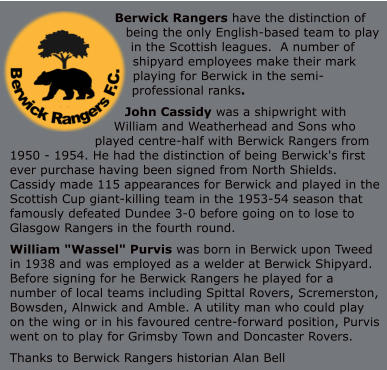
The shipyard also established itself in the social life of the town. A football team, Fairmile United, played in the North Northumberland League while a
number of workers also played semi-professionally with Berwick Rangers. Of these, the most well-known of whom were John Cassidy, a shipwright
with William Weatherhead and Sons, and William "Wassel" Purvis who worked as welder at the yard (see panel above).
* Berwick Advertiser - 20.12.51
Launches, Fitting Out and Sea Trials
Launch days were proud occasions for the yard and crowds of
spectators would gather to witness the spectacle particularly
on those days when vessels would be launched sideways. The
launch of a vessel was usually marked by ceremonies
attended by owners, their representatives, senior figures
from the yard and local dignitaries. While ships were being
built owners and their representatives would visit the yard to
see how work was progressing and agree modifications.
The layout of the Quay Walls site meant that space could be
at a premium particularly when the yard had several vessels
under construction at the same time. As a consequence, two
launch techniques were used. The traditional method of
launching involved vessels being lowered into the water from
the slip on bogies. Where this method was deployed, (see
photo right), some of the fitting out would often be carried
while the vessel was still on the stocks. The sideways launch
technique whereby vessels slid into the water on greased
timber runners was altogether more spectacular. Ships
launched in this manner including Rosehaugh, Sea Otter and
many yachts and fishing vessels that would have their
superstructures added later. Photo sequences showing the
launch of the fishing vessels Janet Helen and Fairweather IV
can be seen in the panels below.
On launch day there would usually be a naming ceremony. An apprentice from the yard would on occasion present a bouquet to the wife or female
representative of the owner who carried out the tradition of naming the vessel. This was the case in 1967 at the launch of the motor yacht Lanesra
(photo below), where yard apprentice Richard Ormston presented a bouquet to Mrs Dudley Robinson. Looking on is Bob Younger, Foreman Engineer who
would later become the yard's general manager.
The launch or completion of a new vessel would also
occasionally be used by the yard's owners as a
marketing opportunity. In 1957 for example, yard
owners Fairmile held a lunch at the Castle Hotel to
mark the launch of the tug El Tigeel. This was
attended by senior figures from the company, local
dignitaries (including the mayor) as well as
representatives from various companies and
organisations from in the shipping world including
the Tees Towing Company, Ridley Tugs,
Grangemouth and Forth Towing and Motor Boat and
Yachting magazine. After lunch the invited guests
were taken to sea onboard the newly completed tug
El Tigeel under the command of the then harbourmaster Captain Richardson
where the vessel was put through it's paces behind Berwick Pier.
The side launch of the fishing vessel Janet Helen was vividly
recalled in a contemporary account written in 1958 by the
co-owner after whom the vessel had been named. The
owners had travelled by train from London the day before to
attend the event. In a letter the writer describes how...
After breakfast they took us down to the boatyard to look at
the Janet Helen, which is her name. They’ve painted her
black with and orange anti-fouling below the water line. At
the moment she is just a hull but she has a beautiful line.
She will have an orange funnel and grey and white
superstructure. We were shown around all the workshops
where the joinery work is nearly finished and also the alloy
parts too. All very interesting. After the little tour we were
taken back to the Castle Hotel with the Managing Director of
the firm and the White Fish Authority representative. We
were amazed when we got back there to see a table laid in
the dining room for about 30 people. All the local dignitaries
including the Mayor and various freemen of the town. The
writer goes on to describe how …we went down to the
yard for the launching ceremony. I had to stand on a
platform bedecked with flags and bunting. I was presented
with a lovely bouquet of yellow roses by the office girl. Then
I cracked the bottle and named the boat – it cracked first time too! The actual launching was very spectacular as she went sideways off the stocks. It
was a really big splash and she took quite a load water over the gunwales but soon righted herself again.
1
Side launches Explained
Unlike those vessels that took to the water from the slip,
those that were side-launched were not moved prior to
launch. Their keels were laid in the usual way on keel
blocks. As sections were built on, blocks were built up
and wedged under the hull at convenient points. These
blocks were fixed together by rough iron bars. These were
about 18 inches long, with 6 inch sharp spikes at right
angles. The bars were hammered into the blocks to keep
them stable. As launch day approached, the side launch
timbers were placed under the vessel, lined up through
and then timber blocks were built between the sliders and
the hull. By a day or two before launch date, the vessel
would effectively be supported twice, once as she'd been
all through building and again on the slides. In the final
hours and minutes, the build blocks were taken out until
only those on the sliders remained. The first time the
vessel's keels moved, was at the moment of launch.
Obviously, it was more important to entirely remove the
build blocks on the river side, as they'd foul the hull as the
vessel slid. Those on the landward side. were mainly left in
place as an 'insurance policy' against the ship 'falling' the
wrong way. In the final few moments before launch, the
whole ship was held on wooden pegs, one per rail. These sat at an angle between two brackets and prevented the top rail from sliding. Above that
peg was a square wooden box which stood up above. This had a big heavy weight in it held on a thin rope. The ropes were run through pullies to a
box with a blade in it. When the blade cut the ropes the weights dropped and simultaneously and took the pegs. At this point gravity took over and
the vessel would head off into the water.
2
Fitting Out, Sea Trials and Delivery
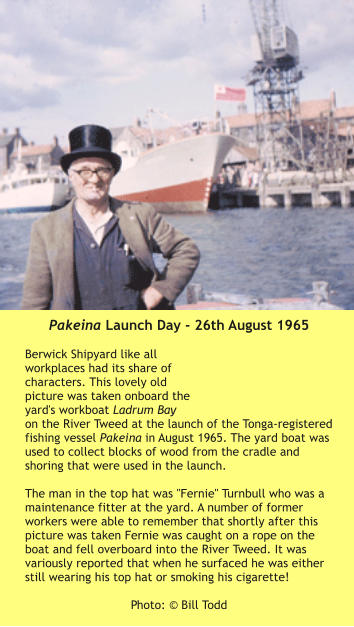
Fitting out of vessels took place either on the Berwick side of
the river in one of the fitting out berths or across at the Tweed
Dock (right). Sea trials were usually carried out to the north of
Berwick Pier to allow systems and equipment to be tested. A
vessels speed would be tested over a 'measured mile'. Two
marker posts stood a mile apart on the cliff path to the north
of Berwick Pier. Once visible from the cliff path these have
since been dismantled and removed. A number of vessels
ventured further afield on trials. Further up the coast there
was another measured mile off St. Abbs. Some ships including
the two RAF Seal Class vessels undertook sea trials in the Firth
of Forth. Smaller vessels such as motor launches, built in the 1950's that were designed for operating on inland waterways, completed their trials on
the River Tweed.
Prior to hand over a number of vessels sailed to Leith where they were placed in dry dock
at the now closed Henry Robb shipyard to allow final hull inspections to be conducted. On
satisfactory completion of trials vessels were either handed over at Berwick or delivered to
owners in their home ports. Former employees interviewed in connection with this project
could recall sailing one of the luxury yachts on a delivery trip from Berwick to its owner in
Barcelona.
Not all vessels built at the yard were delivered to their owners by sea. During the 1950's
small vessels like Dastour pictured below were taken by road to deep-water ports and
shipped to destinations overseas. Completion and delivery schedules were often tight.
Former employees could recall occasions when workers were still at work applying a final
coat of paint while vessels were being transported through the town on trailers. The yard
lorry would follow behind the trailer to collect the workers and return them to the yard.
1.
Extracts from personal correspondence reproduced with permission and thanks to Gillian Bonsall.
2.
Information provided by former yard employee Michael Ross.






www.berwickshipyard.com



