

Other Vessels
The number of ‘one offs’ designs built at Berwick was indicative of
the versatility and adaptability of the yard in meeting new
challenges in a competitive environment. During the Fairmile years
the company was able to draw on the talents of their own Surrey-
based team of naval architects and designers.
An interesting vessel was Tarway, a 83’ liquid tar tanker completed
in April 1958. The vessel was designed to carry a crew of three and
was originally equipped with an electrically driven Albany pump
capable of discharging 6,000 gallons per hour from four oil-tight
cargo tanks fitted with heating coils. Powered by a Gardner 5L3
engine Tarway developed a speed of 7 knots. In 2006 Tarway was
operating under its original name as a dredger based on the Solent
having previously been based at Teignmouth while in the ownership
of Pike-Ward. From 2009 the vessel was renamed Starway before
reverting to its original two years later when it underwent
conversion to a live aboard barge and moved to Lot’s Ait, Brentford
on the River Thames. Tarway is registered on the National Historic
Ships Register (Registration No. 3757)
Similar in design to the luxury yachts for which Fairmile became
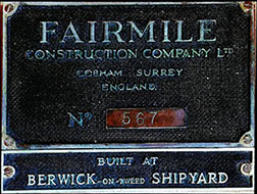
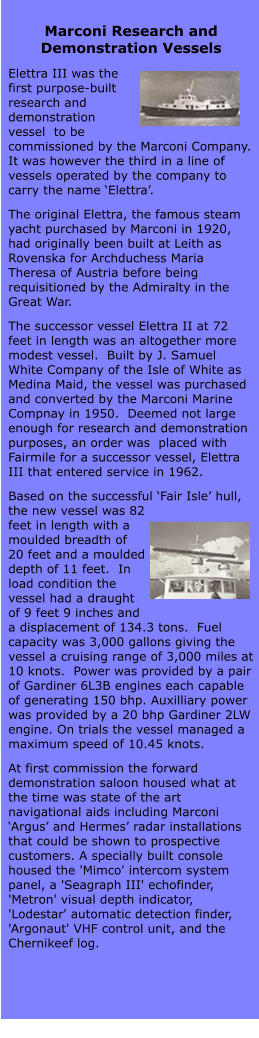
famous, Elettra III
(Yard No. 567), was a
research and
demonstration vessel
built for the Marconi
International Marine
Communication
Company Ltd.
Launched by Lady
Radley, wife of Sir
Gordon Radley (the
then chairman of Marconi),on a snowy day in March 1962, Elettra
III was designed to showcase the company’s latest marine
communication and navigation equipment. Remembered by many former Berwick yard workers as ‘Electra’, Elettra III replaced Elettra II to
become the latest vessel to take its name after the famous steam yacht Elettra owned by the Marchese Marconi (see panel below).
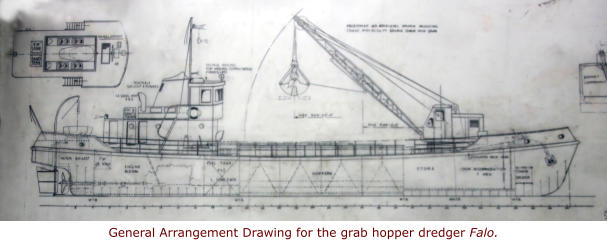
The launch of the grab hopper dredger
Falo in April 1967 underlined the
importance of overseas markets for
Fairmile. The vessel was ordered by the
Board of Trade and the Crown Agents
acting on behalf of the Government of
Gambia.
At 112' long Falo, by Berwick standards,
was one of the bigger vessels to be
constructed at the yard. Maximum carrying
capacity was 3000 cubic feet of sand or
gravel gathered via a long jib Priestman-
Lyon crane. A Kelvin Type T.8 engine
provided an operational speed of 8 knots.
The 2005 Lloyds Register confirmed that
Falo (IMO 6710918) was still in service and
operated by the Government of Gambia.
The final vessel to be built at Berwick was
a 120’ three-masted 230 ton steel
schooner Audela built for International Air
Holdings and launched in April 1979 while
the yard was in receivership. The size and
lines of the vessel made a big impression
with locals. The Berwick Advertiser of the
5th April 1978 described how, ‘Huge crowds watched the launching of the schooner the biggest and certainly the most graceful of any vessel
built at the yard’.
At the time of it's construction Audela was equipped with state-of-the-art equipment
that allowed the helmsman to both steer and trim the sails using a pedal-operated
pneumatic system located under the ship's wheel. Power was provided by two 175
h.p. Gardner engines giving a cruising speed of 8 knots and a range of around 6,000
miles under power. The vessel’s seven permanently rigged sails could be furled,
unfurled and completely stowed in under five minutes.
The building of Audela was not without incident however. In December 1978 the
vessel's giant alloy masts that had been manufactured in France became jammed in
the Shore Gate just a few yards from their final destination while being transported
by trailer. Six months later, while being fitted out in the Tweed Dock, workmen had
to jump clear when Audela tilted after grounding while berthed at low tide.
When trials had been completed the vessel headed to Poole, Dorset with some of the
workforce onboard before heading to Cowes for sail adjustments. Thereafter the
vessel operated between the United States, West Indies and the Mediterranean.
Some years later when Audela was advertised for sale, a Monaco based ship broker
wrote… This modern sailing vessel has ship like proportions and gives a feeling of
great strength.
When Audela set sail in August 1979 it brought to an end shipbuilding on the River
Tweed. Shortly afterwards the remaining assets of the yard were disposed of.
A series of photos showing the vessel at different stages of construction can be seen
here.





www.berwickshipyard.com


